A mature rotary vane vacuum pump is rarely the most visible component on a production line. Yet in food packaging, vacuum leak detection, drying systems, central vacuum stations, heat-treatment equipment, and high-vacuum systems, it often determines whether the process remains stable, repeatable, and efficient.
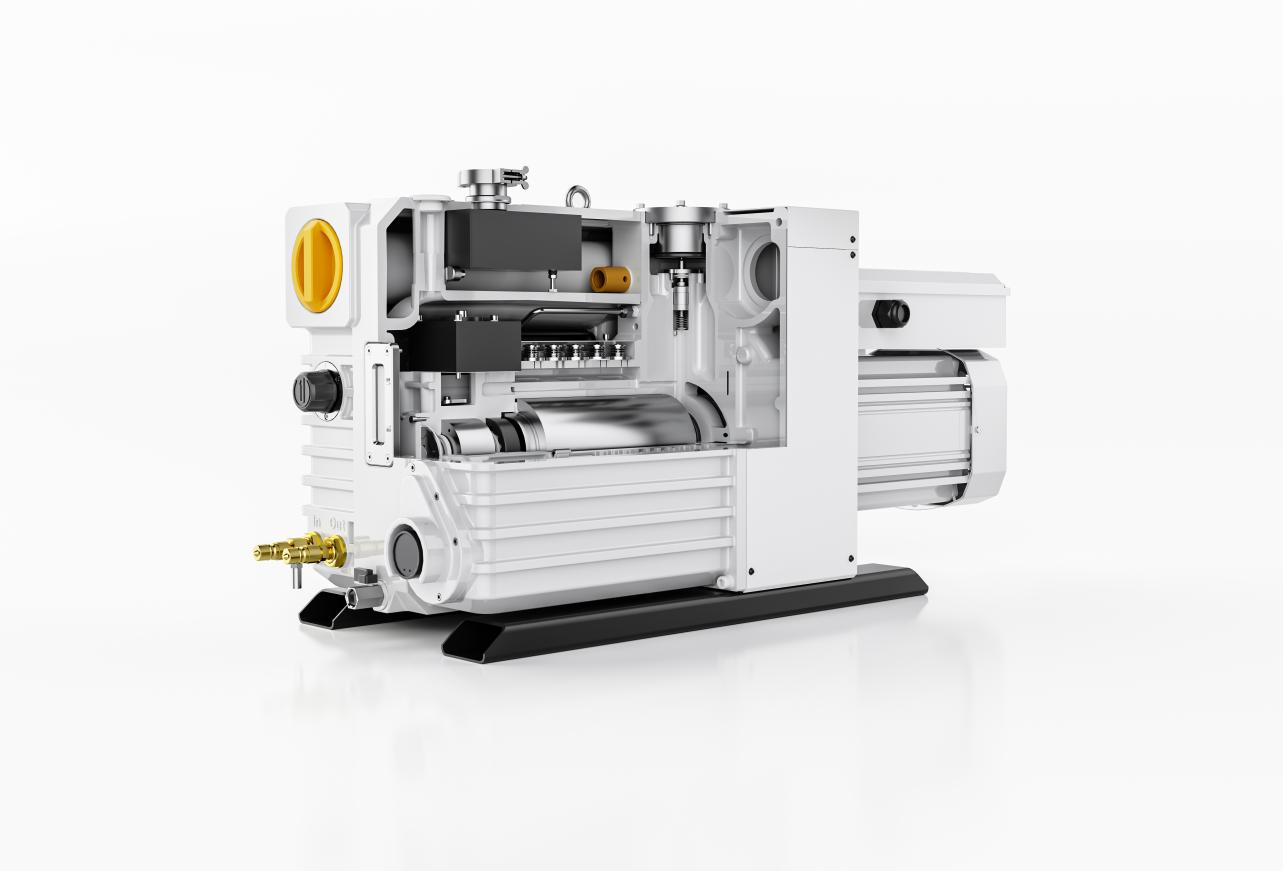
Cutaway view of an oil-sealed rotary vane vacuum pump
It may be installed beside a food packaging machine or built into a vacuum leak detector. It may supply a central negative-pressure station, or operate as the backing pump for a vacuum furnace, vacuum dryer, Roots pump, or other high-vacuum equipment. In each case, it quietly performs the same essential duties: evacuating the chamber, maintaining pressure, and repeating the cycle reliably.
For engineers who understand the process, a vacuum pump is never an optional accessory. VALUE Vacuum develops vacuum solutions from the customer’s operating conditions outward, because several apparently small details directly influence production performance:
• Vacuum stability determines whether packaging and sealing remain reliable.
• Evacuation speed affects machine cycle time and production throughput.
• Resistance to oil emulsification influences maintenance frequency.
• Anti-suckback performance after shutdown affects chamber cleanliness and system safety.
Behind these everyday engineering requirements, the oil-sealed rotary vane vacuum pump remains one of the most widely used and thoroughly proven types of industrial vacuum equipment. VALUE rotary vane vacuum pumps are designed for these real operating conditions.
A proven rotary vane vacuum pump remains relevant because its engineering value comes from reliability, application range, and consistent performance—not from novelty alone.
Vacuum technology has evolved from early piston and mercury pumps used in scientific experiments to oil-sealed mechanical pumps, molecular pumps, dry screw pumps, Roots pumps, and complete vacuum systems. Through every stage of that development, one pump type has remained a familiar part of industrial equipment: the rotary vane vacuum pump.
The basic technology gap between rotary vane pumps is often smaller than the difference in engineering execution. Material treatment, machining and assembly accuracy, oil-circuit design, and the ability to handle real gas loads cannot be understood from a parameter table alone.
The operating principle is straightforward. Changes in volume between the vanes, rotor, and pump chamber draw in, compress, and discharge gas. Pump oil lubricates the moving parts while also providing sealing and cooling. This allows an oil-sealed rotary vane vacuum pump to start pumping from atmospheric pressure and provide stable performance across the rough- to medium-vacuum range.
That is why rotary vane pumps continue to play an important role in food packaging, vacuum clamping and handling, vacuum drying, leak detection equipment, laboratory instruments, vacuum furnaces, and high-vacuum backing systems.
VALUE Vacuum began manufacturing rotary vane vacuum pumps in 1996. Over three decades, the company has produced nearly ten million units and accumulated field experience across a broad range of industrial operating conditions. This history has reinforced one conclusion: mature equipment does not always need to stand at the front of every technology trend, but it must complete the same demanding task reliably, day after day.
Mature equipment proves its value through stable performance in repeated, real-world operating cycles. |
A vacuum pump for food packaging must evacuate quickly, tolerate moisture, and maintain stable performance during frequent, long-running production cycles.
In food packaging equipment, the vacuum pump often determines the machine’s practical efficiency. The chamber must be evacuated quickly, air must be removed from the package, package conformity must remain consistent, and the production line must continue running. The real value of the pump is not one fast evacuation cycle, but its ability to remain stable through high-frequency operation over long periods.
Food packaging environments can also include water vapor, oil mist, dust, and frequent starts and stops. If the pump cannot handle moisture, the vacuum pump oil may emulsify. If routine maintenance is difficult, production downtime becomes more expensive.
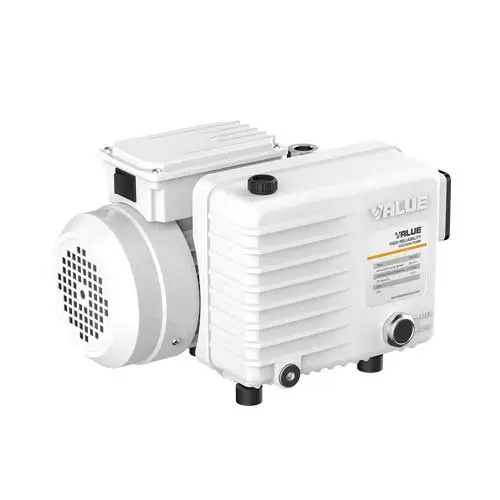
The VALUE VSV Series Single-Stage Rotary Vane Vacuum Pump is a proven choice for these applications. It is suitable for food packaging, cold-chain transportation, negative-pressure stations, vacuum clamping and handling, and other general industrial vacuum processes where stable pumping, mature construction, and convenient maintenance are more important than achieving the lowest possible pressure.
VALUE single-stage rotary vane pumps use oil circulation and air cooling as standard, eliminating the need for an external cooling-water line. In a food-processing facility, this means fewer pipes, fittings, potential leakage points, and maintenance items. IP54 protection also helps the pump cope with the dust and splashing commonly found in industrial workshops.
For food processors, a reliable industrial vacuum pump is not merely an accessory. It is part of the production line’s ability to run consistently.
A central vacuum station must provide stable negative pressure to multiple points of use while remaining easy to deploy, maintain, stop, and restart.
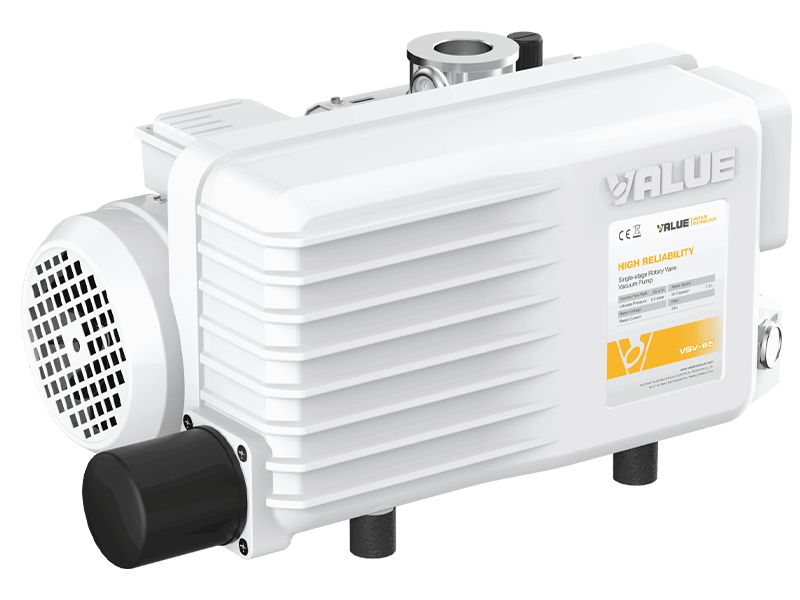
VALUE single-stage rotary vane vacuum pump for general industrial vacuum applications.
In automated production lines, laboratories, utilities, and negative-pressure systems, vacuum pumps are frequently integrated into pumping stations. Rather than serving one isolated process, the station supplies stable vacuum to several points of use. Pick-and-place handling, vacuum fixtures, pressure holding, and equipment evacuation may all depend on the same vacuum source.
The requirements are practical:
• Stable continuous operation.
• Straightforward maintenance.
• Pumping capacity matched to the system demand.
• Safe shutdown and restart behavior without excessive risk to the process.
A single-stage rotary vane pump is well suited to many general industrial vacuum applications. Its advantage is not one headline parameter, but the overall operating experience: easy installation, familiar maintenance, and adaptability across a wide range of basic vacuum duties.
Many industrial processes do not require the deepest possible vacuum. They require a vacuum pump that works reliably every time. |
Vacuum leak detection depends on a stable backing vacuum because repeatability, background pressure, and minimum detectable leak rate are all influenced by the backing pump.
Vacuum leak testing is an important quality-control step for automotive components, refrigeration and household appliances, valves and pipelines, liquid-cooling systems, battery equipment, and many other products. Leak-detection systems may be evaluated by leak rate, test cycle, and measurement accuracy, but all of these depend on a stable vacuum environment.
• Unstable preliminary evacuation reduces test repeatability.
• Insufficient ultimate pressure prevents the system background pressure from falling as required.
• Oil or gas flowing back after shutdown can contaminate the chamber and the workpiece.
For general evacuation and rough-vacuum duties, a single-stage rotary vane pump can provide a stable vacuum foundation. When the required pressure is lower and the pump must serve as the backing pump in a leak-detection system, a dual-stage rotary vane vacuum pump is usually the more suitable choice.
The VALUE VRD Series Dual-Stage Rotary Vane Vacuum Pump uses two-stage compression to achieve a lower pressure range and support systems with stricter requirements for evacuation stability and ultimate pressure. For leak-detector manufacturers, backing-pump reliability can directly affect the performance of the complete machine.
As a general comparison, the ultimate total pressure of a single-stage rotary vane pump may be in the 10⁻¹ mbar range, while a dual-stage pump can reach the 10⁻³ mbar range. This two-order-of-magnitude difference matters because backing-pump pressure affects system background pressure and, in turn, the minimum detectable leak rate. When an application has a defined vacuum requirement, pump selection is not simply a question of choosing a “better” model; it is an engineering decision about whether the system can meet the test standard.
A reliable leak-detection system begins with a reliable vacuum foundation. |
Gas ballast helps an oil-sealed rotary vane vacuum pump discharge condensable vapor before it condenses and contaminates the pump oil.
In laboratories, chemical processing, pharmaceuticals, vacuum drying, degassing, deaeration, and some freeze-drying applications, the pump often handles water vapor or other condensable gases. These conditions are demanding for an oil-sealed rotary vane vacuum pump.
If vapor condenses inside the pump chamber, the vacuum pump oil may emulsify, lubrication performance can deteriorate, ultimate pressure can worsen, and maintenance intervals can shorten. Users may assume the pump is not durable, when the actual problem is that moisture in the process gas has not been managed correctly.
Gas ballast addresses this issue by introducing a controlled amount of gas during compression, helping condensable vapor leave the pump before condensation occurs. For rotary vane pumps, gas ballast is not simply an optional accessory. It is an important design feature for wet-load operation.
VALUE rotary vane vacuum pump series are designed around real operating conditions. Users can select the appropriate pump and configuration for food packaging, vacuum drying, wet pumping, and general industrial applications.
On VALUE single-stage rotary vane pumps, two gas-ballast settings can raise the permissible water-vapor pressure to approximately 15–50 mbar. In many food-packaging and general wet-pumping duties, this helps discharge water vapor before condensation and lowers the risk of oil emulsification.
A good vacuum pump is not defined only by how low it can pump, but by how reliably it handles the actual gas load. |
In vacuum heat treatment, the backing pump establishes the pressure conditions required for Roots pumps and higher-vacuum equipment to start and operate stably.
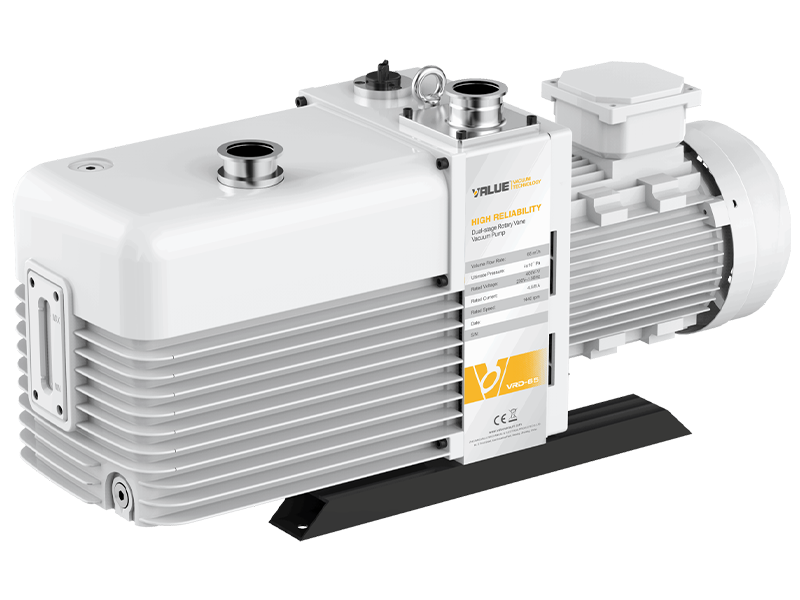
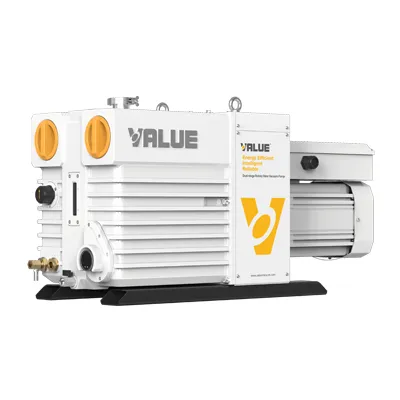
VALUE dual-stage rotary vane vacuum pump for lower-pressure and backing-pump duties
Vacuum heat-treatment furnaces, vacuum brazing systems, vacuum degassing equipment, and related processes normally use a complete vacuum system rather than a single pump. The system may combine an oil-sealed rotary vane pump, Roots pump, valves, piping, and control equipment.
The rotary vane pump frequently serves as the backing pump. It first evacuates the system from atmospheric pressure to a lower pressure range, creates the starting conditions required by the Roots pump or other high-vacuum equipment, and maintains stable backing pressure during operation.
If the backing pump is unstable, the downstream vacuum system will also be difficult to stabilize.
A VALUE dual-stage rotary vane vacuum pump is suitable for applications requiring lower ultimate pressure, continuous operation, and stronger system stability. Its dual-stage structure, oil-supply design, and anti-suckback protection improve adaptability in complex vacuum systems.
A built-in gear pump provides forced oil circulation. This addresses a common issue during start-up near atmospheric pressure: conventional oil supply may not maintain sufficiently stable oil pressure, which can reduce vane lubrication. Forced lubrication keeps oil-circuit pressure within the intended range even at higher inlet pressures, which is particularly important for long-term continuous backing-pump operation.
The backing pump may not be the most visible component in a vacuum furnace, but it is one of the foundations of system reliability. |
Harsh-environment rotary vane vacuum pumps add corrosion resistance, oil-circuit protection, leakage control, and oil-mist management for demanding gases and wet loads.
Not every application is clean, dry, or mild. In laboratories, scientific instruments, chemical analysis, and special industrial processes, a vacuum pump may face high water-vapor loads, complex gas compositions, or mildly corrosive gases. A conventional rotary vane pump may still provide the required pumping performance, but corrosion resistance, oil-leak control, oil-mist treatment, and long-term reliability become more demanding.
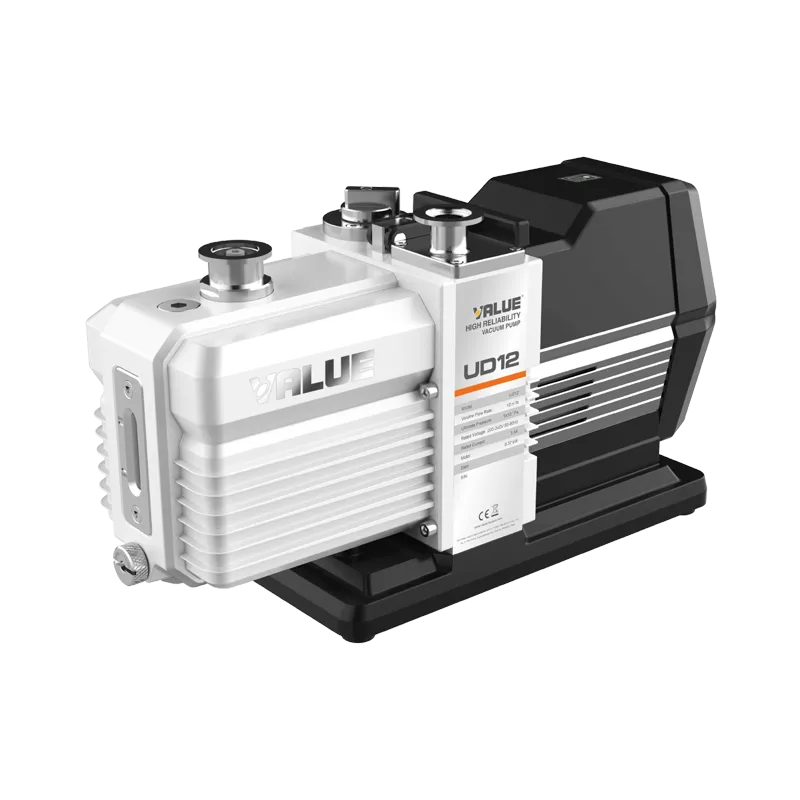
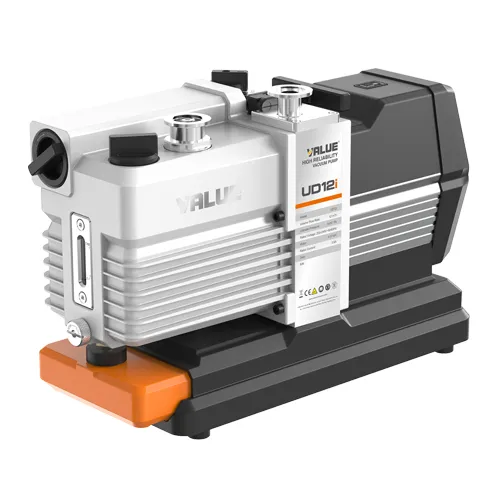
For these conditions, VALUE developed the UD Highly Reliable Vacuum Pumps for Harsh Environment. The product line retains the stable, mature, and serviceable characteristics of oil-sealed rotary vane technology while strengthening corrosion treatment on critical components, oil-circuit protection, and oil-mist filtration.
This is not simply a replacement for a standard rotary vane pump. It extends the application boundary of oil-sealed rotary vane technology into processes with more complex gases, heavier moisture loads, and higher reliability requirements.
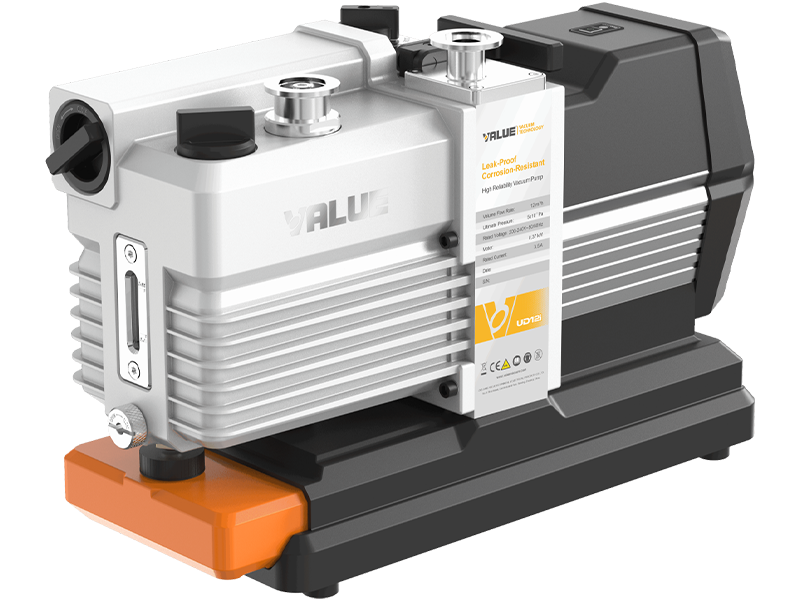
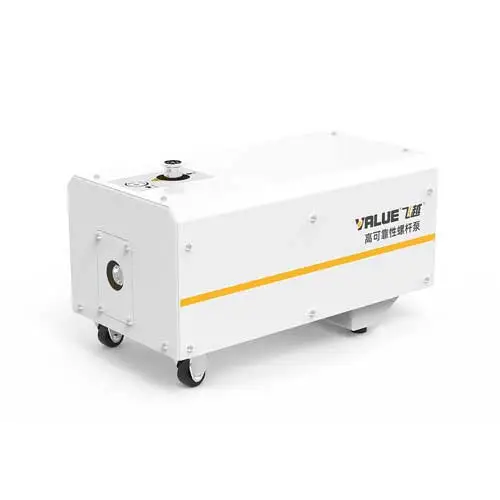
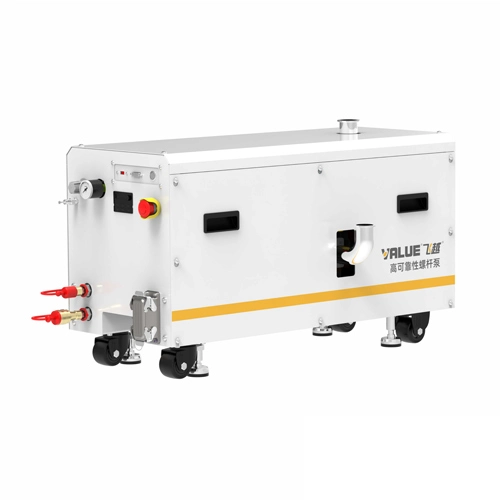
VALUE UD Highly Reliable Vacuum Pumps for Harsh Environment
Precision-equipment users evaluate not only pumping speed and ultimate pressure, but also noise, oil-leak risk, corrosion resistance, maintenance demand, and long-term stability.
VALUE incorporates magnetically coupled drive systems with hermetic containment shells, brushless DC motors, and integrated oil-mist filters in selected products. The magnetic-drive design eliminates conventional dynamic shaft seals and reduces the risk of oil leakage, while brushless DC motors and integrated oil-mist filtration help improve service life, operational stability, and exhaust cleanliness.
The company has also developed rotary vane vacuum pumps for mass-spectrometry applications. In scientific and analytical instruments, pump value is often measured through long periods of stable operation: the pump should require little attention while continuing to perform its task reliably.
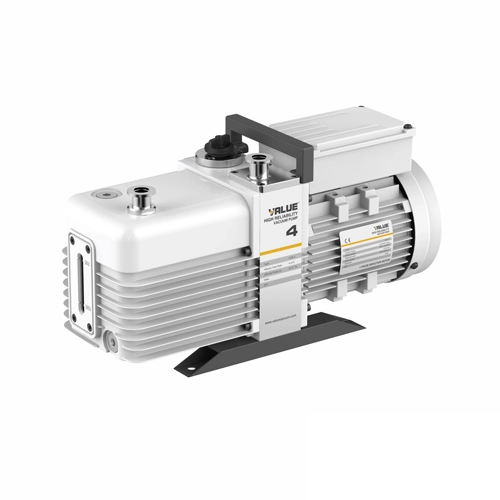
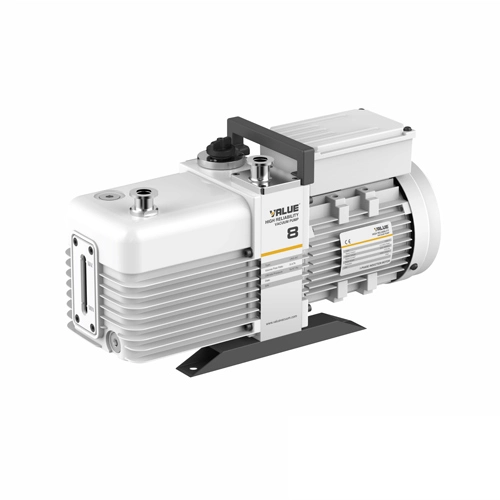
VALUE offers single-stage and dual-stage rotary vane vacuum pumps across a broad pumping-speed range so users can match pressure, gas load, duty cycle, and maintenance priorities to the application.
Pump Type | Pumping Speed Range | Key Features | Typical Applications |
Single-stage rotary vane pump | 4–280 m³/h | Oil circulation and air cooling; IP54 protection; two gas-ballast settings | Food packaging, negative-pressure stations, vacuum clamping and handling, and general industrial duties where long-term stability is more important than the lowest ultimate pressure. |
Dual-stage rotary vane pump | 2–275 m³/h | Built-in gear pump for forced lubrication; dual anti-suckback protection | Leak-detection systems, vacuum heat-treatment backing, freeze-drying equipment, and applications with stricter ultimate-pressure and system-stability requirements. |
For general industrial applications, pumping speed, operating cost, and ease of maintenance may be the first priorities. For precision or harsh environments, cleanliness, material compatibility, water-vapor handling, and corrosion resistance may define the correct solution. VALUE provides a selection path for both types of requirement.
Rotary vane vacuum pumps remain widely used because they solve fundamental industrial vacuum requirements with a practical balance of performance, cost, and reliability.
From food packaging and central vacuum stations to leak detection, vacuum drying, and heat treatment, the oil-sealed rotary vane vacuum pump continues to support processes that must run predictably every day.
• It can begin evacuating directly from atmospheric pressure.
• It uses a mature structure with a clear maintenance approach.
• It can operate independently or serve as the backing pump in a vacuum system.
• It balances cost, performance, and long-term reliability.
VALUE rotary vane vacuum pumps are developed around these application benefits. They are not designed to chase a concept. They are designed to establish vacuum, maintain vacuum, and support the process under real operating conditions.
For an industrial user, the final questions are not whether the specification sheet looks impressive, but whether the pump can keep the equipment running, make the process repeatable, reduce maintenance and downtime, and adapt to the actual site.
VALUE's answer is application-based vacuum stability and dependable long-term operation. |
For pump selection, provide the required pumping speed, target pressure, gas composition, water-vapor load, operating cycle, installation environment, and system interface. This allows the vacuum pump and configuration to be matched to the process rather than selected by one parameter alone.